LabLens: Inspect the Rollout, Follow the Evidence
LabLens: Inspect the Rollout, Follow the Evidence
Hackathon project · Track: Gemini 4 Argon in Hard Tech · October 2026
LG Electronics
TL;DR
A robot rollout log answers what the joints did, and the camera answers what the scene looked like, but neither tells a reviewer where to look first. LabLens gives Gemini 4 Argon one rollout, a question and eight overview frames, lets it request exactly two deterministic tools (a CSV signal window and an exact frame bundle), and returns a report in which every sentence points to a frame or a computed number. On the failed rollout T2012 it narrowed 1,796 samples to samples 1600–1620, the 0.7 s in which the can tips over.
1,796 → 21 samples in the episode versus samples in the interval Gemini 4 Argon flagged first (1600–1620, 53.33–54.00 s video time)
2 calls · 1 tool round hard budget per investigation; 14 unique frames and 18 computed signal summaries reached the model
112.7 s measured live run: 37.6 s plan call, 0.4 s server tools, 74.8 s review call on Vertex AI (ADC)
Overview
Problem
A failed SO-101 pick-and-place rollout is ~60 s of two camera streams and 12 joint signals. Reviewers scrub video by hand, and a general-purpose model asked to “explain the failure” mixes what was recorded with what it guesses, and can confuse a policy rollout with a teleoperation demo, which changes what action.* even means.
Approach
A bounded investigation loop. Call 1 (plan) sees the question and 8 overview frames and asks for one signal window and one frame bundle. The server computes them deterministically from the CSV and the original MP4s. Call 2 (review) must tie every claim to the evidence IDs it was given, under a fixed authority class.
Outcome
On T2012 the plan call chose samples 1500–1620 and a detail window 1570–1620. The review call reported the can upright through sample 1603 and on its side by sample 1620, aligned with a wrist_flex peak at 1602 and gripper opening toward 1620, and left contact force explicitly unverified.
What a raw log leaves out
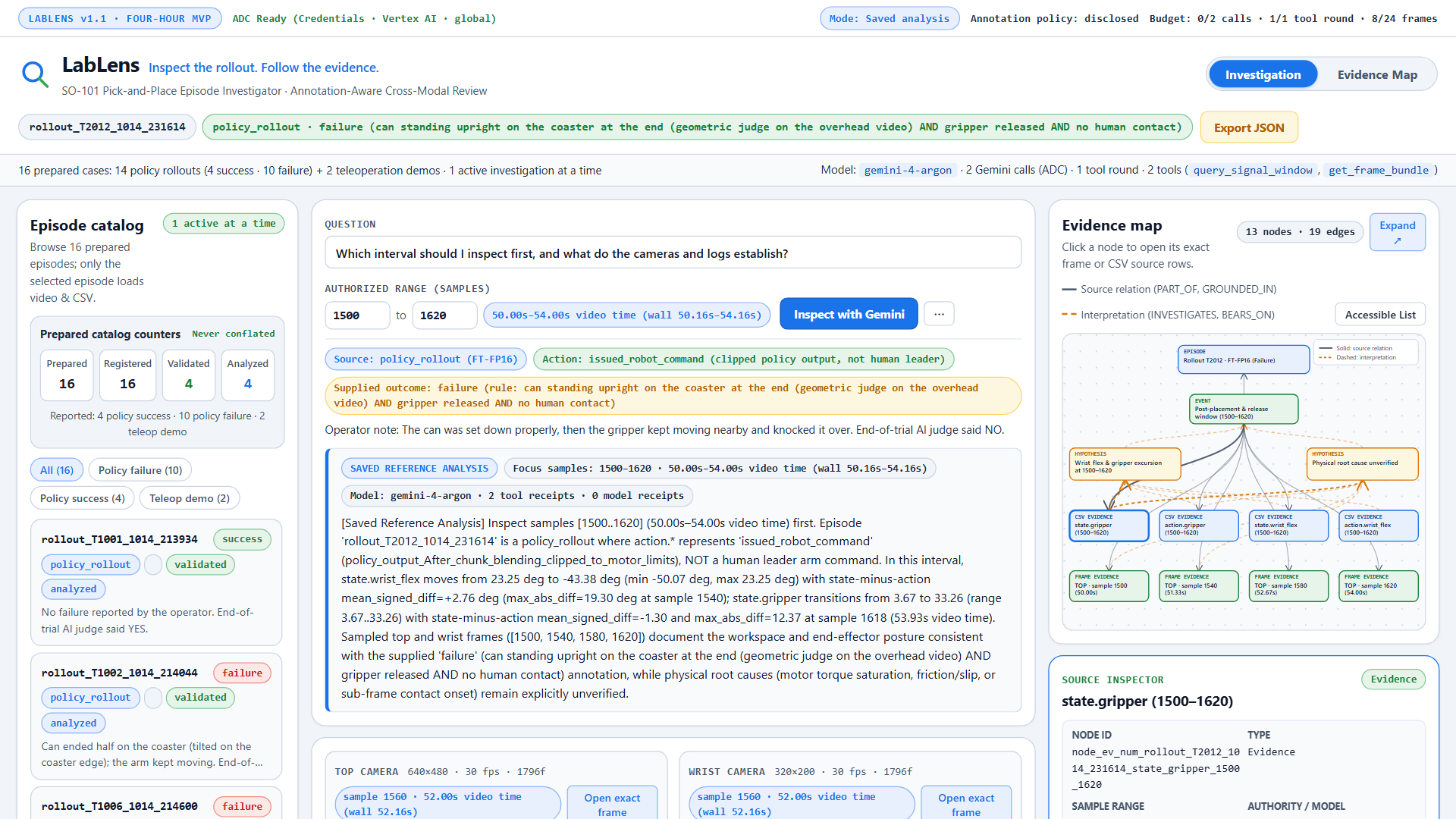
The same 12 columns mean different things in different episodes. In a policy rollout action.* is the issued robot command (policy output after chunk blending and motor-limit clipping); in a teleop demo it is the human leader arm. The outcome label is a consensus of an overhead-camera geometric judge and a blind video re-judge, and is kept separate from the operator note. LabLens reads all three from episode.json and states them before the model speaks.
The loop: two calls, two tools, one episode
Call 1 · plan Where to look
Question + supplied outcome + 8 overview frames (top and wrist at samples 1500, 1540, 1580, 1620). Gemini 4 Argon returns a structured InspectionPlanResponse: one signal window and one frame window.
→
Server · tools Compute, don’t guess
query_signal_window computes min, max, mean, delta and state-minus-action gaps over every row (121 rows, 39 ms). get_frame_bundle decodes exact original frames with PyAV (8 frames, 349 ms). Each result gets an evidence ID and a SHA-256 of its source.
→
Call 2 · review Claim with receipts
14 unique frames + 18 computed facts. The EvidenceReviewResponse labels every item as computed fact, visual observation, hypothesis or unresolved, and schema validation rejects overclaims such as “verified physical cause”.
Results on rollout T2012
The model picks the interval where the failure happens
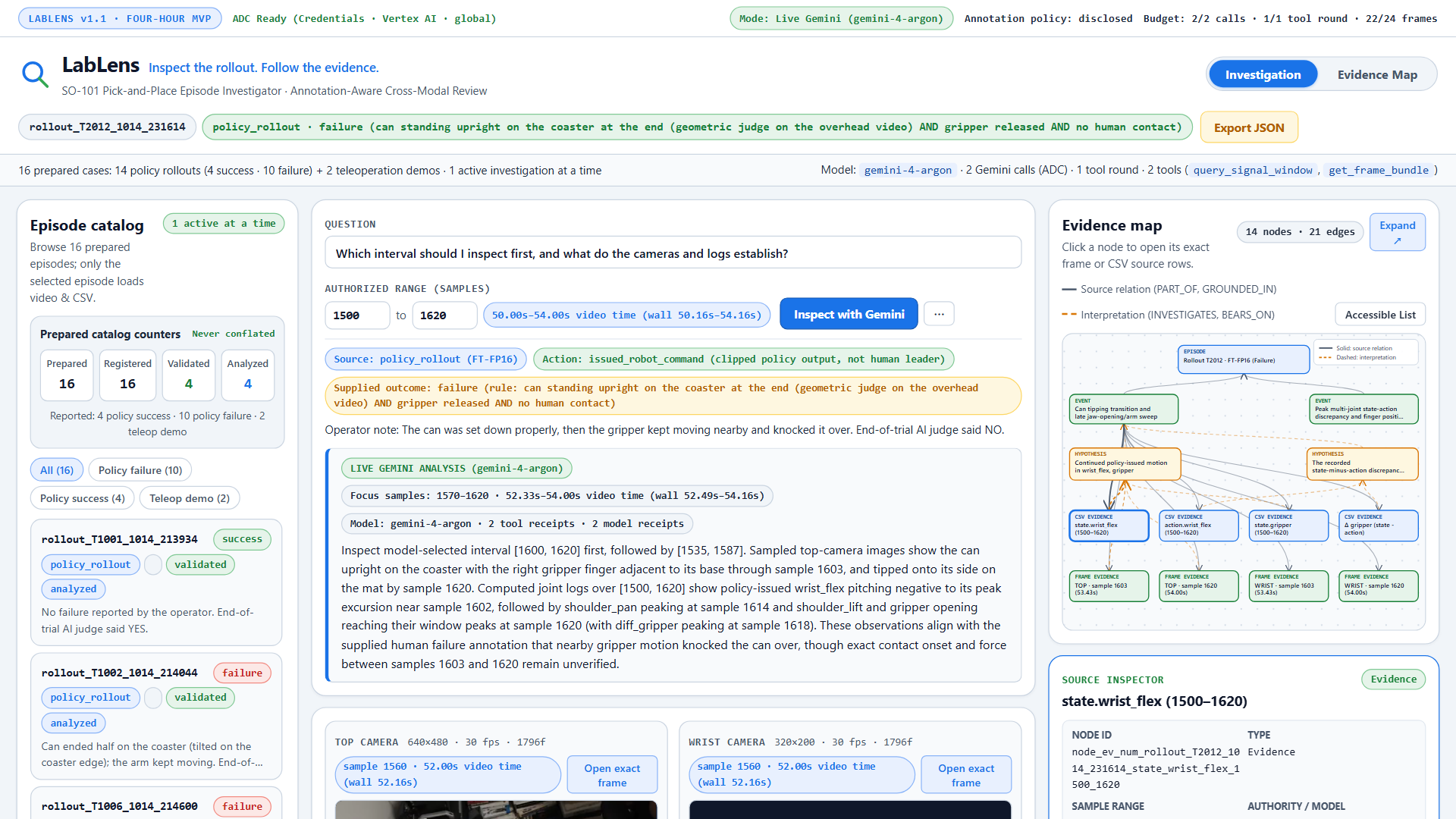
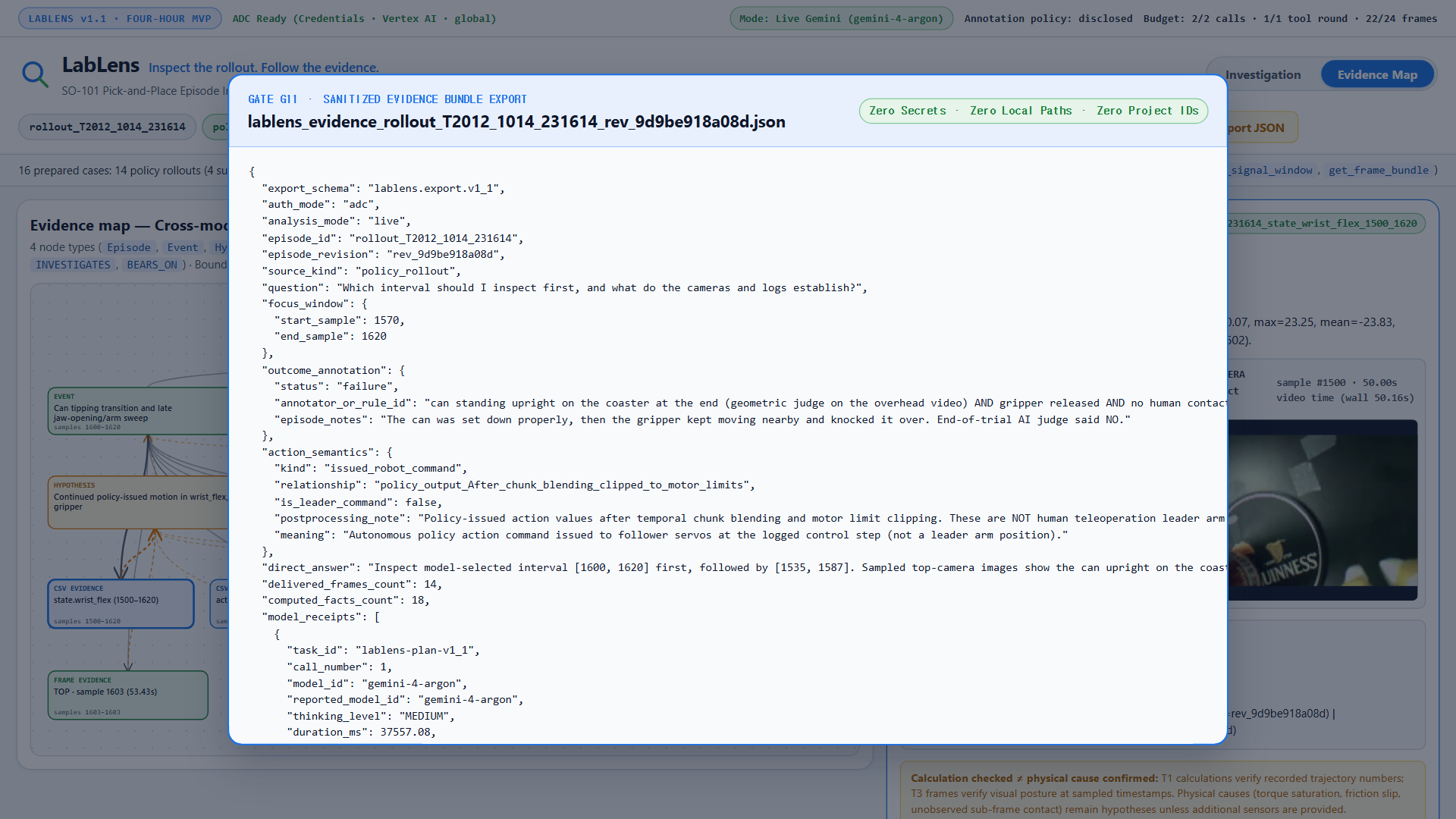
Gemini 4 Argon’s answer: “Inspect model-selected interval [1600, 1620] first, followed by [1535, 1587]. Sampled top-camera images show the can upright on the coaster … through sample 1603, and tipped onto its side on the mat by sample 1620.” The supplied operator note for this episode says the can was set down properly and the gripper then knocked it over; the flagged window is where that happens.
Computed facts behind the sentence
| Signal (samples 1500–1620) | First | Last | Δ | Peak at |
|---|---|---|---|---|
| state.wrist_flex (deg) | 23.25 | −43.38 | −66.64 | 1602 |
| state.shoulder_lift (deg) | −16.84 | 24.84 | +41.67 | 1620 |
| action.shoulder_pan (deg) | −1.43 | −19.86 | −18.42 | 1610 |
| state.gripper (% open) | 3.67 | 33.26 | +29.59 | 1620 |
Every row is recomputed by the server from trajectory.csv; the model can cite these numbers but cannot produce them.
Hypotheses stay hypotheses
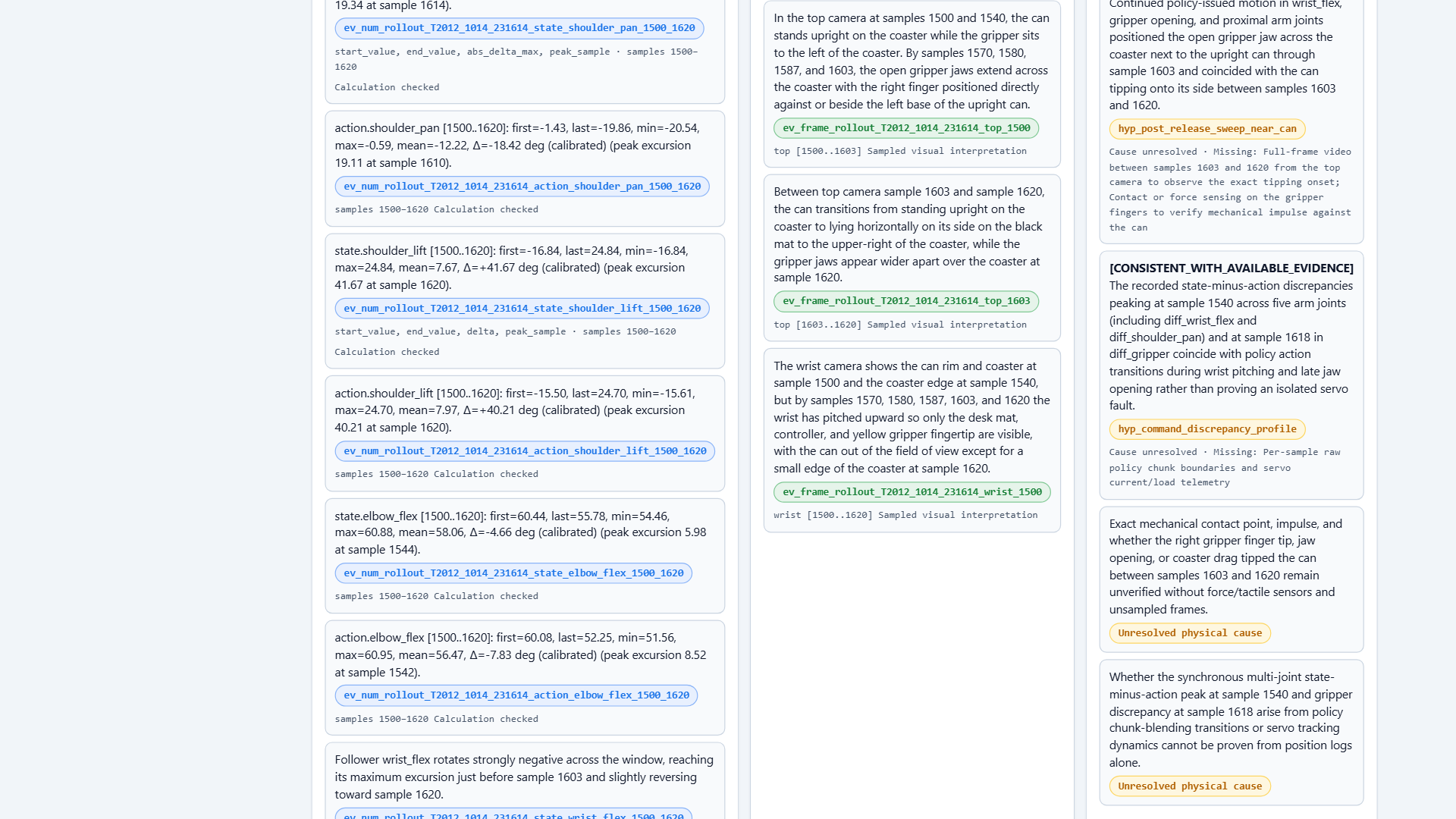
Both hypotheses carry cause unresolved and list the missing evidence: frames between samples 1603 and 1620, contact or force sensing, servo current. Calculation checked ≠ physical cause confirmed.
Every node opens its source
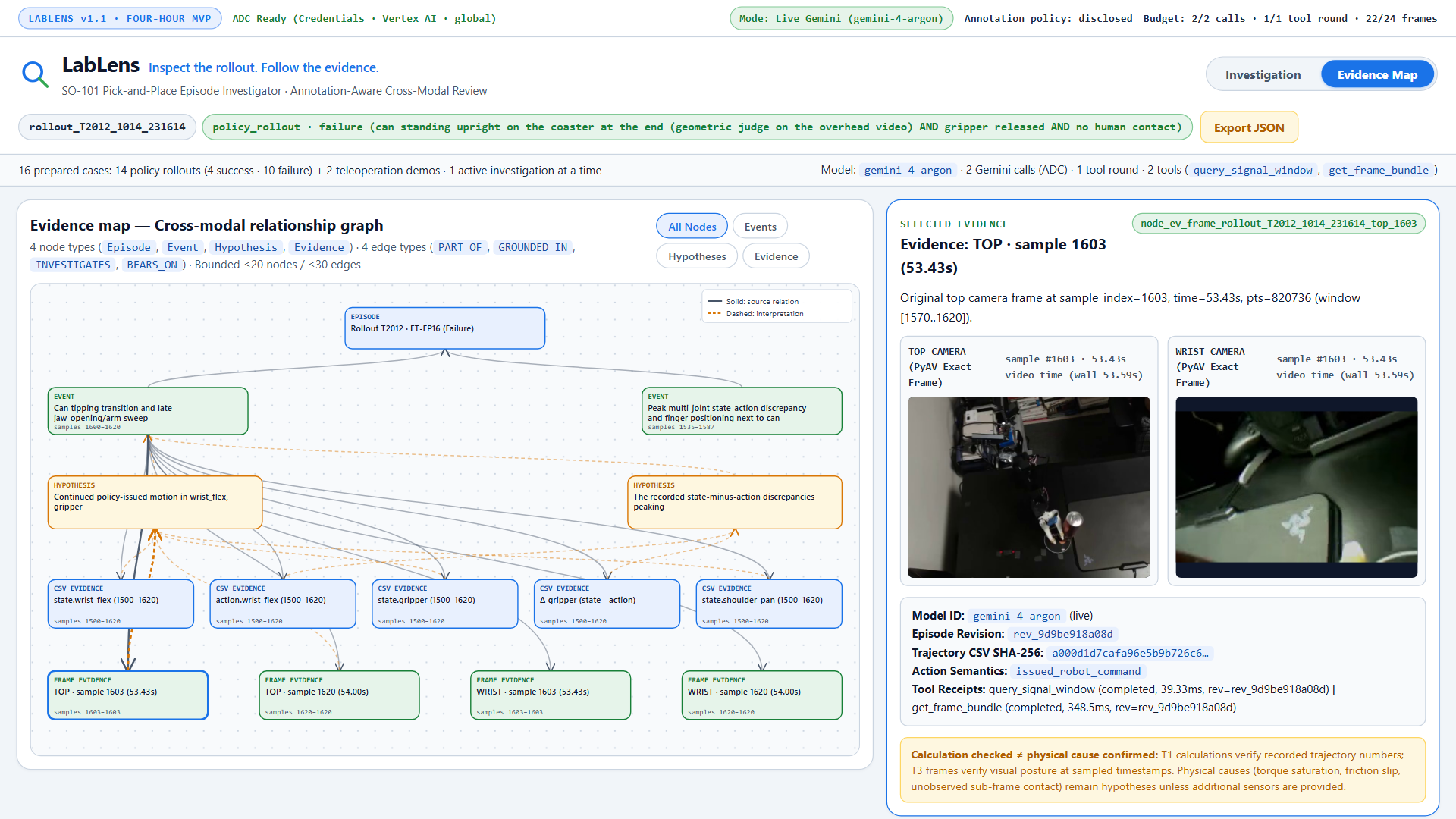
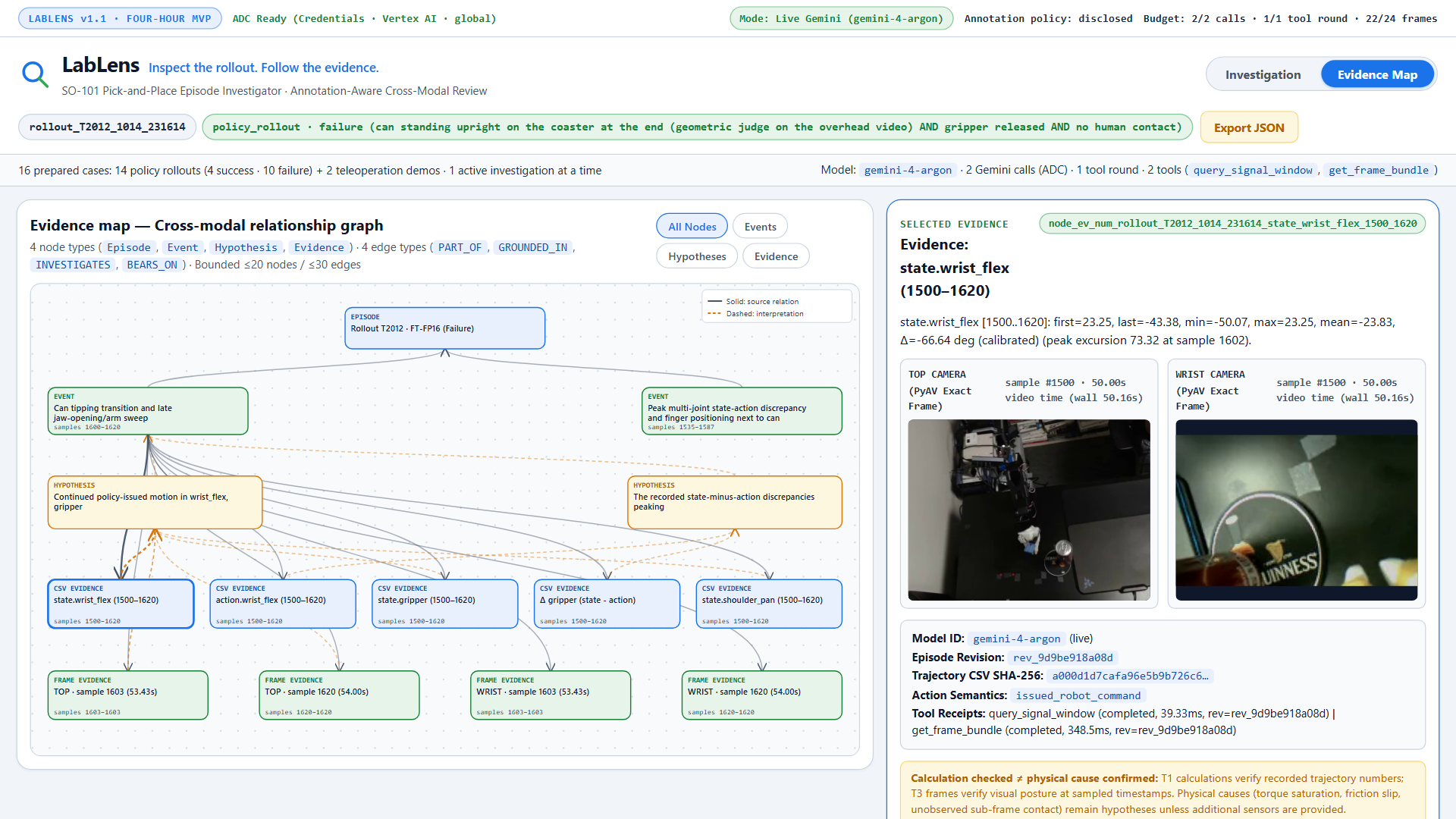
The Evidence Map is bounded to ≤ 20 nodes and ≤ 30 edges with no orphans. Solid edges are recorded relations (PART_OF, GROUNDED_IN); dashed edges are interpretation (INVESTIGATES, BEARS_ON). Clicking any evidence node shows what was recorded, not what was concluded.
Receipts for the live run
- The operator selects one episode; switching episodes cancels any running investigation.
- The operator approves the run with a server-side secret; there is no unattended or batch model call.
- Call 1 (
lablens-plan-v1_1) returns one plan; the server runs at most one tool round with at most two tools. - Call 2 (
lablens-review-v1_1) returns the report; any claim without a matching evidence ID, or with a forbidden phrase, fails schema validation. - Export writes a sanitized JSON bundle: no secrets, no local paths, no project IDs.
Measured on Vertex AI (global), thinking level MEDIUM
| Step | Model / tool | Duration | Input | Output |
|---|---|---|---|---|
| Call 1 · plan | gemini-4-argon |
37.56 s | 20,855 tok · 8 frames | 2,608 tok |
| Tool T1 | query_signal_window |
0.04 s | 121 rows · 12 signals + 6 gaps | 18 facts |
| Tool T3 | get_frame_bundle |
0.35 s | samples 1570, 1587, 1603, 1620 | 8 frames |
| Call 2 · review | gemini-4-argon |
74.76 s | 36,932 tok · 14 frames | 5,895 tok |
| Total | 112.70 s |
Takeaways and limits
Takeaways
- Let the model choose where to look; let the server compute what is there.
- Source semantics are part of the evidence: a rollout and a teleop demo must never be described the same way.
- A short, bounded loop with receipts is easier to trust than a long free-form explanation.
Limits
- One episode per approved run; 16 prepared episodes (14 ACT policy rollouts: 4 success, 10 failure; 2 teleop demos).
- Sparse frames can miss events between samples; the 30 fps cameras and joint encoders cannot establish contact force.
- Annotation-aware review, not blind outcome classification or root-cause diagnosis.
Provenance
Every number on this page comes from the receipts of the live run exported by the app. Backend (FastAPI, PyAV, google-genai with ADC), frontend and the 13 release gates were built during the event; all 13 gates pass. Code is Apache 2.0; the SO-101 episode recordings are CC BY 4.0.
Citation
@misc{kang2026lablens,
  title        = {LabLens: Inspect the Rollout, Follow the Evidence},
  author       = {Kang, Chanseok},
  year         = {2026},
  howpublished = {\url{https://github.com/goodboychan/LabLens}}
}